World Environment Day: A Sustainable Future Starts with All of Us

by guest author, Kyla Greenham, Manager of Environmental Sustainability, Toronto Zoo
Every year on June 5, people come together around the globe to celebrate World Environment Day – an awareness day, and a reminder that protecting our environment depends not only on global commitments and large-scale solutions, but also on the choices we make every day.
At the Toronto Zoo, World Environment Day is especially meaningful because environmental sustainability is woven into everything we do – the decisions we make and the actions we take.
Caring for wildlife and protecting biodiversity does not stop at animal care and wildlife conservation programs. It also means reducing our environmental footprint, restoring natural habitats, conserving resources, and working together to create a healthier future for both people and wildlife. We all have a part to play.
Sustainability in Action at the Toronto Zoo
The Toronto Zoo envisions a Zoo whose operations produce an overall benefit to our natural environment, allowing people, wildlife and wild spaces to thrive. To support this vision, the Toronto Zoo has a TZNet0 Environmental Sustainability Plan. This plan renews and enhances the Zoo’s commitment to preserve, protect and ultimately enhance the earth’s living systems.
As part of the sustainability plan, the Zoo is working toward ambitious goals by 2030, including achieving net-zero greenhouse gas emissions, net-zero potable water consumption, zero waste to landfill, and restoring habitats across the globe.
While these are long-term goals, at the Toronto Zoo progress happens through thousands of actions taking place every day.
Where Sustainability Takes Shape
While some of the Toronto Zoo’s measures to support environmental sustainability are happening behind-the-scenes, others, like the Zoo’s reusable cup program and electric vehicle charging stations, are designed not only to reduce the Zoo’s environmental impact but to inspire and empower guests to make sustainability part of their everyday lives.
From floating wetlands to intelligent waste sorting, here is a deeper look at some of the ways the Toronto Zoo is putting the TZNet0 Environmental Sustainability plan into action:

Friendlier: If you’ve visited the Toronto Zoo recently, you may have noticed Friendlier reusable takeout containers in the restaurants — a meaningful step in reducing single-use plastics and keeping waste out of the environment.
Through this program, your meal becomes an opportunity to make a difference: by paying a 50-cent deposit, guests can choose to return their container for a refund or donate that amount to support the Toronto Zoo’s vital wildlife conservation work. It’s a simple action with a powerful ripple effect for the planet and the species we’re working to protect.
Floating Wetlands:
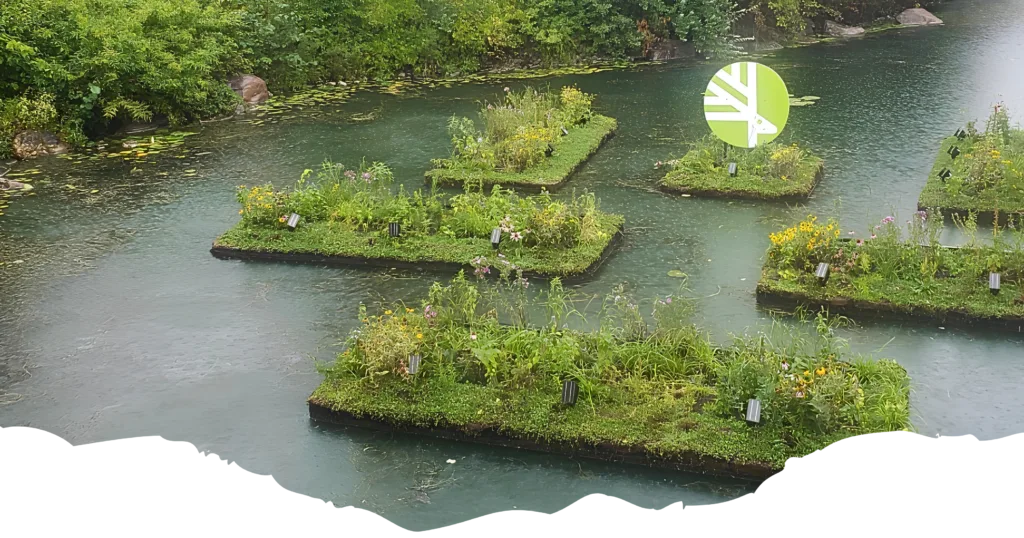
Did you know that the Toronto Zoo is home to wetlands? While these spaces may appear to have formed naturally, the ponds were human-made with a purpose: they were created to collect stormwater runoff. The runoff brings in many nutrients and silt, creating an algal bloom and stagnation, which makes the water uninhabitable for most organisms.
Floating wetlands are large, porous structures planted with native wetland species that act as natural filters. They help shade the ponds, reduce evaporation, and keep the water cooler for native wildlife. Over time, and with proper maintenance, these floating wetlands become fully integrated into the ecosystem, providing habitat for birds and insects as well as basking areas for aquatic reptiles.
High-Efficiency Heat Pump Retrofits:
The Toronto Zoo’s Energy Retrofit Project is a cornerstone initiative in its Net Zero Transition, focused on replacing conventional fossil fuel–based heating systems with high-efficiency electric heat pumps across the Americas, Indo-Malaya, and African Rainforest pavilions to significantly reduce greenhouse gas emissions while maintaining precise indoor climate conditions essential for animal health and well-being.
As one of the Zoo’s most impactful decarbonization efforts, the retrofit is designed to achieve substantial reductions in natural gas consumption, improve overall energy efficiency, and establish the foundation for full electrification of building systems.
Intelligent Waste Sorting:
The Toronto Zoo has piloted the OSCAR intelligent waste management system, developed by Intuitive AI, to improve waste diversion performance and enhance visitor engagement with sustainability. Installed in high-traffic areas, like Peacock Café, OSCAR uses artificial intelligence to guide users in real time on how to correctly sort their waste, reducing contamination across recycling and organics streams—one of the key barriers to achieving effective diversion.
This system was implemented to support the Zoo’s objective of reaching net-zero waste to landfill by 2027, while also serving as an educational tool that transforms a routine action into a moment of environmental awareness.
SARIT Electric Micromobility Pilot:
By participating in the SARIT micromobility partnership, the Toronto Zoo is helping test new low-carbon transportation solutions in a real-world setting. In collaboration with York University Lassonde School of Engineering and EVLY Inc., the Zoo has piloted multiple iterations of the compact electric SARIT vehicle.
The initiative was undertaken to explore practical alternatives to conventional gas-powered utility vehicles, supporting the Zoo’s broader fleet electrification goal of transitioning to a fully electric fleet by 2030.

ICEnergy System:
In collaboration with Toronto Hydro, Ontario Power Generation and the City of Toronto, the Toronto Zoo assessed the ICEnergy thermal storage system, a technology designed to improve energy efficiency and reduce peak electricity demand. The project evaluated how the system could produce and store ice during off-peak hours for use in cooling during peak demand periods, thereby reducing strain on the electrical grid and lowering associated emissions.
The findings provided critical insight into the applicability of thermal energy storage in a temperate climate like Toronto and informed future decision-making on integrating demand management and energy optimization strategies into the Zoo’s net-zero pathway.
Small Actions, Big Impact for Wildlife and Wild Spaces
Environmental sustainability and wildlife conservation are deeply connected. Climate change, habitat loss, pollution, and resource consumption affect ecosystems around the world and the species that depend on them. By reducing our own impacts and demonstrating practical solutions, we can help create healthier environments where people, wildlife and wild spaces can thrive.
World Environment Day reminds us that meaningful change happens collectively. Toronto Zoo staff, volunteers, guests, and community members all play an important role. Small actions like choosing reusable options, reducing waste, conserving water, supporting biodiversity, or making sustainable transportation choices can create significant impacts when multiplied across thousands of people.
As an organization dedicated to connecting people, animals, conservation science, and traditional knowledge to fight extinction, the Toronto Zoo recognizes that creating a sustainable future requires action from all of us.
This World Environment Day, we encourage everyone to take one step, big or small, toward protecting our planet. Because every action for the environment is also an action for wildlife.